


Before Leeds Had a Charter: Wade’s Charity and Five Centuries of Civic Life

On 13 July 2026, Leeds will celebrate a remarkable milestone: 400 years since the city received its first Royal Charter from King Charles I. The Charter of 1626 marked an important moment in Leeds’ development, granting the town a greater degree of self-governance and laying foundations for the civic institutions that would help shape the city we know today.
Across Leeds, organisations, communities and residents will be reflecting on what this anniversary means. It is an opportunity to celebrate the city’s achievements, acknowledge the people who have contributed to its success, and consider the future of one of the UK’s most dynamic and diverse cities.

For Wade’s Charity, however, the Leeds 400 celebrations also invite a different reflection.
When Leeds received its Royal Charter in 1626, Wade’s Charity had already existed for almost a century.
As the charity approaches its own significant milestone, its 500th anniversary in 2030, it is worth considering what it means for an organisation to have served Leeds across five centuries of change. In many ways, the story of Wade’s Charity is inseparable from the story of Leeds itself.
A Leeds Before Leeds
Modern Leeds is a city of more than 800,000 people. It is a centre for finance, healthcare, technology, education, culture and innovation. Its skyline continues to grow, its universities attract students from across the world, and its communities reflect a diversity that would have been unimaginable to earlier generations.

Yet, in 1530 when Wade’s Charity was founded, Leeds was barely recognisable as the city we know today. Home to fewer than 3,000 people, it was little more than a modest market town – only around twice the size of modern-day Masham. The wool trade was becoming increasingly important, but the explosive growth that would transform Leeds into one of Britain’s great industrial cities still lay centuries in the future.
Life back then was hard: poverty, disease, poor harvests and economic deprivation were common features of everyday existence. Support for those in need depended largely on families, churches, local benefactors and charitable institutions.
In this context, charitable giving was not simply an act of generosity. It was an essential part of community life.
The founders of charitable trusts and endowments were often motivated by a belief that communities prospered when people accepted responsibility for one another. Their gifts helped provide support, opportunity and stability in an unpredictable world.
The creation of Wade’s Charity belongs to this tradition. Founded during the reign of Henry VIII, it began with a bequest from Thomas Wade, who in 1530 left money in his will to “remain and go to the use of mending, upholding and keeping of the highways about Leeds”. Long before the emergence of the modern welfare state, Wade’s Charity was already rooted in a practical idea of civic responsibility: that local resources should be used to maintain and improve the shared fabric of the town.
What makes Wade's remarkable is not simply that it was established in this period, but that it has remained connected to Leeds for almost five centuries. Few institutions founded in Tudor England continue to serve the same city through assets held for public benefit. That continuity is unusual and provides a unique perspective on Leeds' own development across the centuries.
The Charter That Changed Leeds
The Royal Charter granted to Leeds in 1626 represented a significant step forward in the town’s development.
According to Leeds City Council, the Charter marked the beginning of Leeds’ journey towards self-governance and eventual city status. It formally incorporated the town and established new structures for local administration, reflecting Leeds’ growing importance as a commercial centre.

The Leeds of 1626 was already changing. Trade was expanding, wealth was increasing and the town’s influence within Yorkshire was growing. The Charter recognised these developments and provided a framework through which Leeds could govern itself more effectively.
Yet the significance of the Charter extends beyond constitutional change. It reflected a broader civic ambition and demonstrated a belief that Leeds was capable of shaping its own future. It was an investment in institutions that could serve not only the people of the day, but future generations as well.
This idea of stewardship runs throughout Leeds’ history. The city's great civic institutions – from Leeds Library and Leeds General Infirmary to the Town Hall and universities – were established by people who sought to leave something of lasting value behind.

Wade’s Charity forms part of that same tradition. As one of the oldest surviving civic institutions in Leeds, its longevity reflects a simple but powerful idea: that assets held in trust can continue to benefit communities long after their original benefactors have passed on.
As Leeds celebrates 400 years of civic development, Wade’s offers a reminder that some of the city’s most enduring institutions began with a commitment to thinking beyond the immediate needs of the present.
Witnessing Four Centuries of Change
The Leeds that received its Royal Charter in 1626 was still largely a market town. Over the following centuries it would become one of the most important industrial centres in Britain.
In 1700, Leeds was still small, home to fewer than 10,000 people.
By the end of the nineteenth century, its population had ballooned to more than 400,000. Mills, factories, canals and railways had transformed Leeds into one of Britain’s great industrial cities.
As Leeds evolved, so did Wade’s. The most significant change came in 1893, when Leeds Corporation, which had assumed sole responsibility for the city’s roads, attempted to take over the charity. This prompted a reimagining of Wade’s purpose, broadening its role into one of social responsibility: “providing and maintaining open spaces for the benefit, recreation and health” of the residents of the Borough of Leeds.

This made sense. While Leeds’ growth had brought prosperity, it had also created new challenges. Overcrowding, pollution and poor public health became pressing concerns as the city expanded. Access to recreation and open space was increasingly seen not as a luxury, but as an essential part of urban life.
It was under this new charitable purpose that Wade’s began acquiring land for parks at the start of the twentieth century. Within a few short years, it had secured parks, recreation grounds and other public spaces across Leeds, helping to ensure that rapidly growing communities retained access to nature and opportunities for recreation.

Today, Wade’s owns approximately 213 hectares, or 526 acres, of green space, including major parks such as Gotts Park & Middleton Park, recreation grounds, woodlands and community spaces across the city (approximately 20% off Leeds’ green space).
The value of these decisions is perhaps even clearer now than it was when they were made. Generations of Leeds residents have used Wade’s land to walk, play, exercise, socialise and connect with nature. Communities have changed, neighbourhoods have evolved and the city has expanded dramatically, yet many of these spaces continue to serve the same fundamental purpose.
In a city that has been continually reinventing itself for four centuries, Wade’s Charity has provided a remarkable degree of continuity. While Leeds has changed beyond recognition, the principle underpinning the charity’s stewardship – preserving assets for the long-term benefit of local people – has remained largely unchanged.
Looking Towards 2030
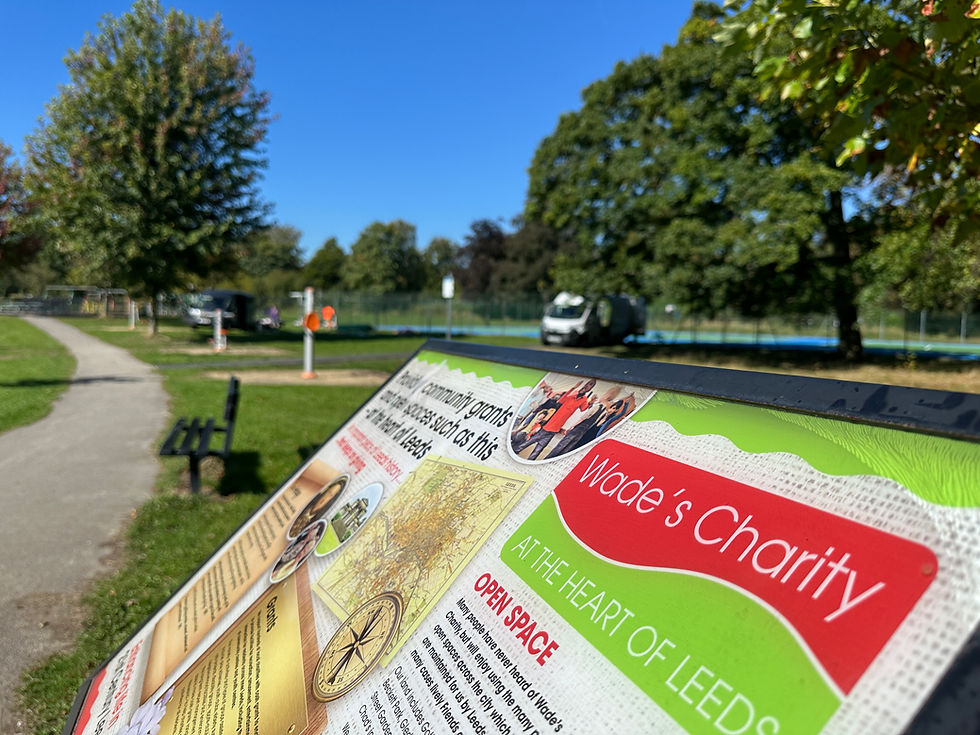
While Leeds celebrates 400 years since its first Royal Charter, Wade’s Charity is looking ahead to its own significant milestone: in 2030, the charity will mark 500 years since its foundation.
Five centuries is an extraordinary span of time. Very few organisations remain active in the communities they were originally established to serve. Yet anniversaries are not only an opportunity to reflect on the past. They are also an opportunity to consider the future.
The challenges facing Leeds in the coming decades will differ from those faced by previous generations. Technological change, demographic shifts, environmental pressures and evolving social needs will all shape the city’s future.
Recent national debates illustrate why this matters. Research published in 2026 by Wildlife and Countryside Link warned that some of England’s poorest communities already experience significantly lower access to nature and green space, and that proposed planning changes could widen those inequalities even further.
Against this backdrop, Wade’s legacy takes on renewed significance. Although the charity owns only a relatively small proportion of Leeds’ public green space, many of its sites are located in or near communities that have historically experienced higher levels of deprivation.

The charity’s founders and trustees may not have used the modern language of environmental justice or health inequalities, but the practical effect of their decisions has been remarkably similar: preserving access to green space for communities that might otherwise have had less of it.
As Leeds looks towards the future, that legacy provides a reminder that decisions made today can continue to shape the city for generations to come.
A Shared Story
The Leeds 400 celebrations rightly focus on the significance of the 1626 Royal Charter and the remarkable journey that has followed. Four hundred years later, Leeds is a confident, diverse and outward-looking city with much to celebrate.

For Wade's Charity, however, the anniversary offers a different perspective. The city's story did not begin in 1626, nor has it been shaped by government alone. Leeds has been built by generations of people and institutions who invested in the future of the place they called home.
When Leeds became a self-governing borough in 1626, Wade's Charity was already approaching its centenary. Four centuries later, both remain part of the fabric of the city.
As Leeds celebrates 400 years since its first Royal Charter, Wade's can look ahead to its own 500th anniversary with a clear sense of purpose. The city has changed beyond recognition since 1530, but the belief that communities are strengthened by long-term investment in shared places and shared futures remains as relevant as ever.
Many thanks to Charles Heaton for writing the piece and allowing me to publish on the Real Yorkshire Blog.
To find out more about Wade's Charity visit www.wadescharity.org
References
Wade’s Charity Web Site
Leeds City Council, Leeds 400 – A Year of Celebration, confirming that 13 July 2026 marks 400 years since Leeds received its first Royal Charter from King Charles I and describing the Charter as the beginning of Leeds’ journey towards self-governance and city status.
https://homenicom.co.uk/area/leeds - population of Leeds in 2026
The Northern Echo. Why visitors are falling for Masham. 9th March 2026.
West Yorkshire Archive Service, Leeds 400, describing the 1626 Charter as a pivotal moment in Leeds’ history and outlining its role in the city’s development.
Local Histories, A History of Leeds – population estimates and historical development of Leeds in the sixteenth century.
Wade’s Charity, Green Spaces and Other Community Green Space pages – information on the charity’s landholdings, acreage and stewardship of parks and green spaces across Leeds.
Laville, Sandra (2026), England’s poorest areas face deepest cuts to green space under planning law changes, report finds, The Guardian, 4 June 2026.
Leeds Observatory, Index of Multiple Deprivation 2025 Summary, for context regarding deprivation patterns across Leeds.
Green Gap Policy Report 2026: How BNG exemptions deepen nature poverty across England’s most deprived communities. Commissioned by the Wildlife and Countryside Link.
www.welcome Leeds.co.uk - History of Leeds
www.discerningleeds.com - history of Wades and Leeds


Comments